Showing posts with label Arizona. Show all posts

Jerome: The Hillside Ghost Town

Arizona

On highway 89A, between Sedona and Prescott, lays the hillside ghost town of Jerome, Arizona.  This quaint little town was built on Cleopatra Hill and founded in 1876.  As you drive up or down the narrow road which weaves around historic buildings, you feel like you stepped back in time.  Some of the buildings are homes and businesses renovated by the many artists who are residence of Jerome.  Other buildings are old historic hotels that are rumored to be haunted or decaying abandoned buildings which were not able to be salvaged.

Jerome was made up of many different characteristics of people, seeking riches from the mines below.  The international blend of people made life in Jerome thrilling and lively.  It began with three prospectors laying claim on the copper deposits they found.  They then sold out to a group that formed the United Verde Copper Company in 1883.  The mining camp consisted of wood and canvas cabin/shacks and was named after Eugene Jerome, who was the principal backer.  Only two years later, the company had to shut down because of the high cost of operations.  William A. Clark took over as the new owner and added a narrow gauge railroad to reduce freight costs.  By the 20th century, the United Verde was the largest producing copper mine in the Arizona Territory.  The canvas cabins no longer existed and replaced by brick and framed buildings.  Jerome had churches, schools, theatres, hotels, shops and a civil center making it a place where many wanted to live.  In 1912, James S. Douglas, started the Little Daisy Mine.  By 1916, Jerome had two mines that had an abundant amount of copper minerals, boasting billions of dollars in profit by investors and financers. 
Jerome was hit with many fires but was always rebuilt.  In 1918, with several fires in the tunnels and dynamiting cracking the buildings and causing the ground to shift, the mines took an enormous beating.  The Little Daisy Mine shut down in 1938 and Phelps-Dodge took over the United Verde in 1935.  In 1953, with copper prices continuously rising and falling and the loss of profits, Jerome’s copper mines shut down for good.

In 1929 the population peaked at 15,000 and was down to about 50 souls living there by the late 50’s.  Today, this peaceful community is thriving thanks to the writers, artists, musicians, historians and families that call Jerome home.


The Bradshaw Mountains

Arizona

Located in central Arizona in the Sonoran Desert sits the harsh black rock terrain known as the Bradshaw Mountains.  Named after William Bradshaw, this mountain range consists of an interior forest, to an exterior desert grassland and shrubbery from the Sonoran Desert surrounding the rocks.

(From Wikipedia)  “The first known settlements in the Bradshaw’s were a group of Yavapai Indians called the Kwevkapaya who built forts and mined copper from around AD 1100 to 1600.  Apaches occupied the area around 1800 as a means of keeping white settlers out.  But by 1863, a party led by William Bradshaw was in the area, followed by the Walker party.  In 1864, a group of five white settlers was attacked by Apaches at what is now called Battle Flat.  One of the settlers went for help, but upon his return found the Apaches had left.  The Walker party found gold, and within a few years, the Bradshaw’s were filling up with settlers mining for gold, silver, and copper.  In the early part of the 20th century, most of the towns that had sprung up were little more than ghost towns.”
Today there are over 40 ghost towns that surround the Bradshaw Mountains.  Along with the cacti, several creatures such as javelinas, mule deer, wild turkey and short-horned lizards make the black rocks and surrounding desert their home.

The Abandoned Dog Track

Arizona

As we got off the highway to Black Canyon City, this abandoned dog track caught our eyes.  I wanted to take photos so we drove around to see if there was an entrance to the grounds.  After being harassed by a buzzard and couldn't find an entrance, we went back to the start of the road, parked the car, and got as close as we could to the building.

This once was a thriving greyhound dog racing track.  In 1982 it was closed and has sat abandoned, deteriorating from the harsh Arizona climate.  I just saw it as another beautiful photo opportunity.


That Darn Buzzard

Arizona


While cruising the back roads in Black Canyon City, we had a buzzard that appeared to be following us.  We stopped the car and tried to get pictures and a video but he wasn't cooperating.  He finally flew away and got bored of the crazy human ladies.

Mayer's White Cemetery

Arizona

Sharon and I had to wait at the cemetery in Mayer for the cemetery crawl contestants to show up.  It snowed most of the time while we were there and the wind was chilly.  This is the first time taking photos of a cemetery with snow on the ground.  It was breathtaking.

Also, don't forget my RedRock Giveaway.


White Tanks

Arizona

I was excited to hear that the mountains near my house not only have petroglyphs but are haunted as well.  The White Tank mountain range is located west of Phoenix near the city of Surprise.  They get their name for the white granite near the base of the mountains and its many depressions also known as “tanks”.   It is believed that the range was formed about 30 million years ago by earthquake activities and detaching from a fault line.  Although the peaks of each range are approximately the same altitude, the tallest is Barry Goldwater Peak at 4,083 feet.  The rocky terrain is beautiful but dangerous.  The mountain range consists of jagged ridges, and bottomless canyons where after a rainfall water will build up and run swiftly down the sheer canyons.

 In the mountains you will find the White Tank Mountain Regional Park, an area where many like to visit and hike.   Many of the areas in this park are undeveloped wilderness with many indigenous species roaming around the desert grounds.  Some of the critters you might see while visiting the park are mule deer, coyotes, javelina, small rodents, and on rare occasions, mountain lions.  Some of the birds found in the park are roadrunners and cactus wren, which is the Arizona state bird.  Since the park is in the desert, many reptiles can be found wandering the area as well.   You can take a guided tour and learn all about the animals and plants found in this natural desert preserve.

One of the main reasons I want to visit the mountain range is the numerous petroglyphs found scattered around the mountains and may predate the Hohokam people.  Approximately 11 archaeological sites were recognized along with 7 Hohokam villages.  There are various trails leading to these sites and villages dispersed and marked for your interests.  You can take as many pictures of the sites and petroglyphs, but all they ask is that you don’t touch them.

The mountains also have stories of paranormal activity.  There have been several UFO sightings over the mountain range, but since the White Tanks are located near Luke Air Force Base, many have been dismissed as being something military.  Some people believe that what they saw was not manmade, but something unexplainable.   Along with the UFO sightings, people have reported ghostly figures and other strange phenomena while hiking the mountains.

What Happened to the Sinagua?

Arizona
Montezuma's Castle

Tucked in the mountains and just outside Sedona is the site where cliff dwellers once lived known as Montezuma’s Castle. The five story dwelling is remarkably well preserved and built in the 12th century by the Sinagua people. They cleverly wedged their lodgings in the rock, high above Oak Creek, which runs through the red rocks of Sedona. Historians can only speculate that they build so high because the spot offered protection from the desert elements. The Sinagua lived in their rock high-rise for over 400 years before disappearing mysteriously.

Another group of Sinagua people established their own community called Tuzigoot. These ruins are located 20 miles from Montezuma’s Castle and built from the natural resources found in the surrounding desert. With all their clever building techniques, the mystery still remains why the Sinagua suddenly disappeared in the 1400’s. Some feel that they may have used up their natural resources or maybe a plague or disease wiped them out, but since there is no written record, no one knows.
My hubby and I are spending our 30th wedding anniversary in Sedona next month. While there, we plan to spend one of our days in Jerome. We also plan to visit Montezuma's Castle, Tuzigoot and the petroglyphs that are all over the rocks of Sedona. I will have lots of pictures and more information on this mysterious group of people known as the Sinagua.

Don't forget my giveaway. Tomorrow morning is the last time you can enter. I will pick the winner in the afternoon.

Tovrea Castle: The Wedding Cake

Arizona

On the east side of Phoenix and sitting in the center of several acres is an unusual structure known as “Tovrea Castle”. The shape of the castle resembles a three-tiered wedding cake which could have been constructed by Buddy (Cake Boss) or Duff (Ace of Cakes) and earned the moniker “The Wedding Cake”. Instead of being constructed with cake mixes and fondant, the castle’s materials consist of wood and stucco in an ornate medieval fashion, imitating the styles from the home country of its builder.

In 1928 an Italian immigrant named Alessio Carraro had purchased 277 acres of barren desert land and began the construction of Tovrea Castle. He had great visions of an extraordinary resort with a plush desert garden surrounding the locality and the castle as its centerpiece. With the vision of Russian gardener, Moktachev, they began converting the desolate desert into an amazing desert garden.

It took two years for the creation of the castle to be completed. Soon after construction was finished, Edward Tovrea, who owned land surrounding Carraro’s, opened a meat packing plant nearby. Not happy with Tovrea and other adjoining landowners bring in livestock; Carraro sold the property, along with its remarkable structure, to Tovrea and his wife Della in 1931.

In 1932 Edward Tovrea passed away and Della decided to keep the castle as her permanent home. After she married William Stuart, it became a winter home until after his death. She again lived at the residence full-time until her death in 1969.

After her death, the Tovrea family trust was in charge of the property but neglected any maintenance that was needed causing the place to simply diminish over time. The once beautiful desert gardens were now dying and ignored with the cacti suffering the most damage. Also the deserted castle was in poor shape making the structure unlivable.

In 1993, the City of Phoenix obtained the land and its wedding cake building deeming the place as a historical structure. In 1990, Tovrea Castle and its surrounding land were listed as a historical property and in 1996 added to the National Register of Historic Places.

The castle has been going through restoration while the gardens are being restored to their former glory. Tovrea Castle was to be giving tours and opening its doors to the public in 2009, but because of the economical issues, it has been delayed. Sharon and I are looking into touring the place. As soon as we do, we will share our pictures, videos and story. BTW, I hear the place may be haunted.

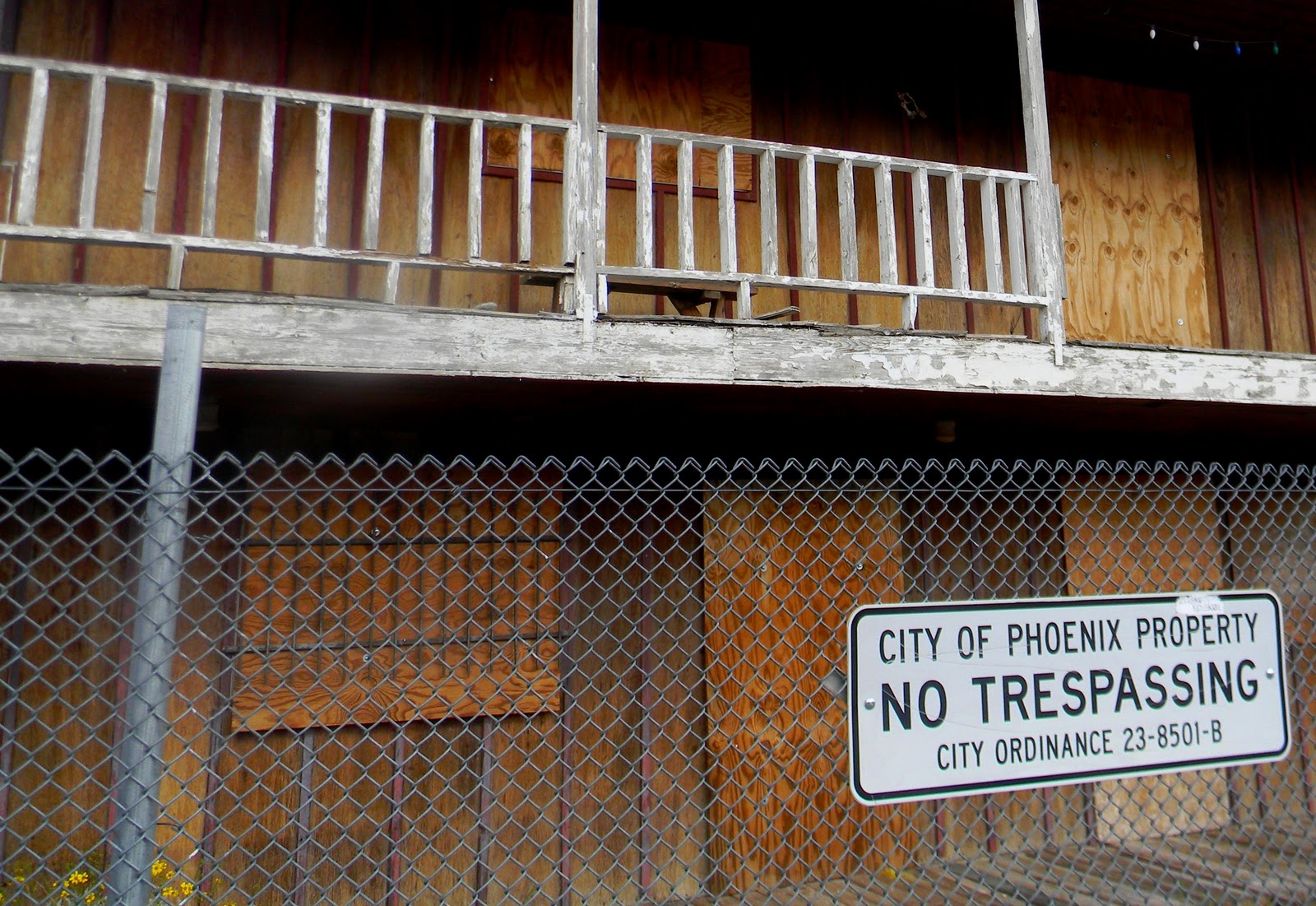
Keep Out!

Arizona


On the outside...


Fan Page on Facebook

Arizona

Check out my fan page on facebook
and click the like button.
Thanks!


Inside Mystery Castle

Arizona

If you thought the outside had a bizarre mix of materials making up the facade of the castle, check out the wacky rooms inside.

unusual guests
desert critter shoes

creepy bunny costume
guest bedroom
Lady of the house


child size armor

the alter
the music room

the bar
antiques in the bar
apparently they partied too much
the bar
have a seat

Humm, I don't recall seeing a bathroom.
Related Posts Plugin for WordPress, Blogger...